



Get in touch

Case study · Design ops

Loupe

Status without the status meeting. A weekly report designers send once, and their manager can read, rank and present.

Role
Product designer and builder
Team
Me, with AI agents
Scope
Web app for designers and managers
Status
In use since March 2026

In real use since March 2026

At a company I can't name because of an NDA. The screens on this page are a de-branded copy with a made-up team.

Source: the company's own Loupe records, counted read-only on 27 October 2026. People are counted as accounts, because the app doesn't log sign-ins. Test and admin accounts are left out.

In short
The project
Loupe is a web app for a design team's week. Designers send one short report per project. Their manager sees the whole team at a glance and downloads the slides for leadership.
The problem
Every Friday my manager chased designers for updates, then rebuilt them into slides by hand. My designer friends booked reviews over DMs and got no credit for sending their update on time.
What I did
I asked my friends and my manager what hurt, then designed one report that both of them could use. Five decisions shaped it: the report in the deck's shape, a Friday deadline with a lock, a forgiving streak, reviews on a timetable, and AI that can only repeat what designers wrote.
My part
Everything: research, product and UI design, the brand, front end, back end and hosting. Claude Code, Cursor and Codex were my engineering team.
Where it is
In use by one in-house design team since March 2026. I can't name the company because of an NDA, so this page shows a de-branded copy with a made-up team that anyone can try as a designer or a manager.

Who it's for

A designer and her manager

Every screen on this page follows these two. They're made up, standing in for the real designers and manager Loupe was built for.

  • Manga portrait of Kemi Adebayo, the designer
    Designer

    Kemi AdebayoProduct designer at Halden

    1. Sends one report a week
    2. Keeps an on-time streak
    3. Books design reviews
    Try it as Kemi
  • Manga portrait of Daniel Mensah, the manager
    Manager

    Daniel MensahDesign manager at Halden

    1. Reads the whole team's week
    2. Sees who shows up on time
    3. Downloads the leadership deck
    Try it as Daniel
How I worked
  1. Listen

    4problems

    From my friends and my manager

  2. Design

    5decisions

    One report, two readers

  3. Build

    295commits

    With Claude Code, Cursor and Codex

  4. Share

    2demo logins

    A designer and a manager

Chapter 01The gap

Friday, 3pm, and nobody knows where the work is.

Every Friday afternoon my manager did the same rounds. A message to each designer: where are you on this? Answers came back in chat, in a shared sheet, on a call. Then the second job started: turning all of it into slides for leadership, by hand, every week.

My designer friends had their own version of Friday. Booking a design review meant messaging around for a free hour, and two people could land on the same one. And the designer who sent a clear update on time, week after week, got the same silence as the one who didn't.

I was one of those designers, so I saw the whole loop from the inside. Nobody was lazy, and the work itself was fine. The trouble was how we reported it.

  1. P1The Friday chaseMy manager collected updates one message at a time, across chat, a sheet and calls.Solved in Decisions 01 and 02
  2. P2The deck by handThe same updates were retyped into slides for leadership every week.Solved in Decisions 01 and 05
  3. P3Reviews over DMsReview slots were booked in messages, with clashes and no record.Solved in Decision 04
  4. P4Work nobody seesDesigners who showed up on time every week got no credit for it.Solved in Decision 03

The four problems Loupe had to solve. Each decision below names the ones it answers, by number.

Chapter 02What I looked at

I asked around before I drew anything.

It wasn't a formal study. I talked to designer friends about the weekly update, and I sat with my manager while the Friday report and the leadership slides came together. What I heard matched what I'd felt: writing the update was never the hard part. Collecting it, chasing it and retyping it was.

Then I tried the tools we had and looked at the obvious ones. Each was good at one corner of the job.

Tools I looked at, what each is good at, and why it fell short
What we could useGood atWhy it fell short
Chat and a shared sheetStarting today, for freeNothing reminds anyone, no two updates look alike, and someone still builds the slides.
Project trackers, like Jira or LinearEngineering ticketsA design week isn't a ticket. Research, reviews and audits don't fit the board, and it makes no deck.
Stand-up bots in SlackAsking a question on a scheduleThe answers end up as a feed of messages, with no milestones, no deck and nothing for reviews.
Booking links, like CalendlyPicking a free slotThey don't know the project, the review stage, or that a session holds three designers.
LoupeOne report a week fills the manager's table and the leadership deck, and reviews run on a timetable.

My scan of the options, written for this case study. Each tool covered one part of the job, and none of them joined the report, the deck and the reviews.

Chapter 03One report, two readers

Write it once, in the shape your manager needs.

This was the idea everything else hangs on. The designer and the manager read the same update, so the designer should write it in the shape the manager uses. Then nobody has to chase it, and nobody has to retype it.

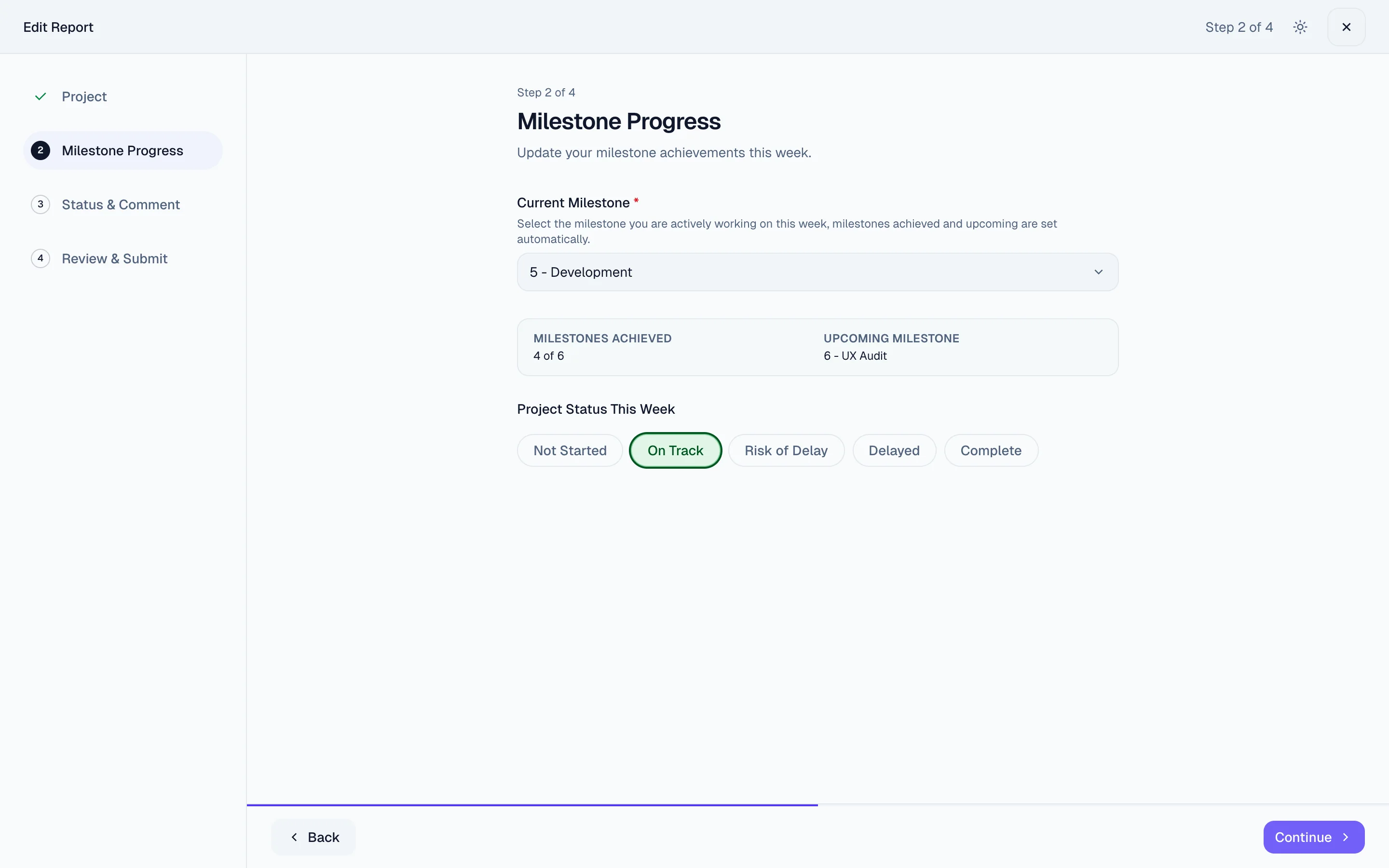
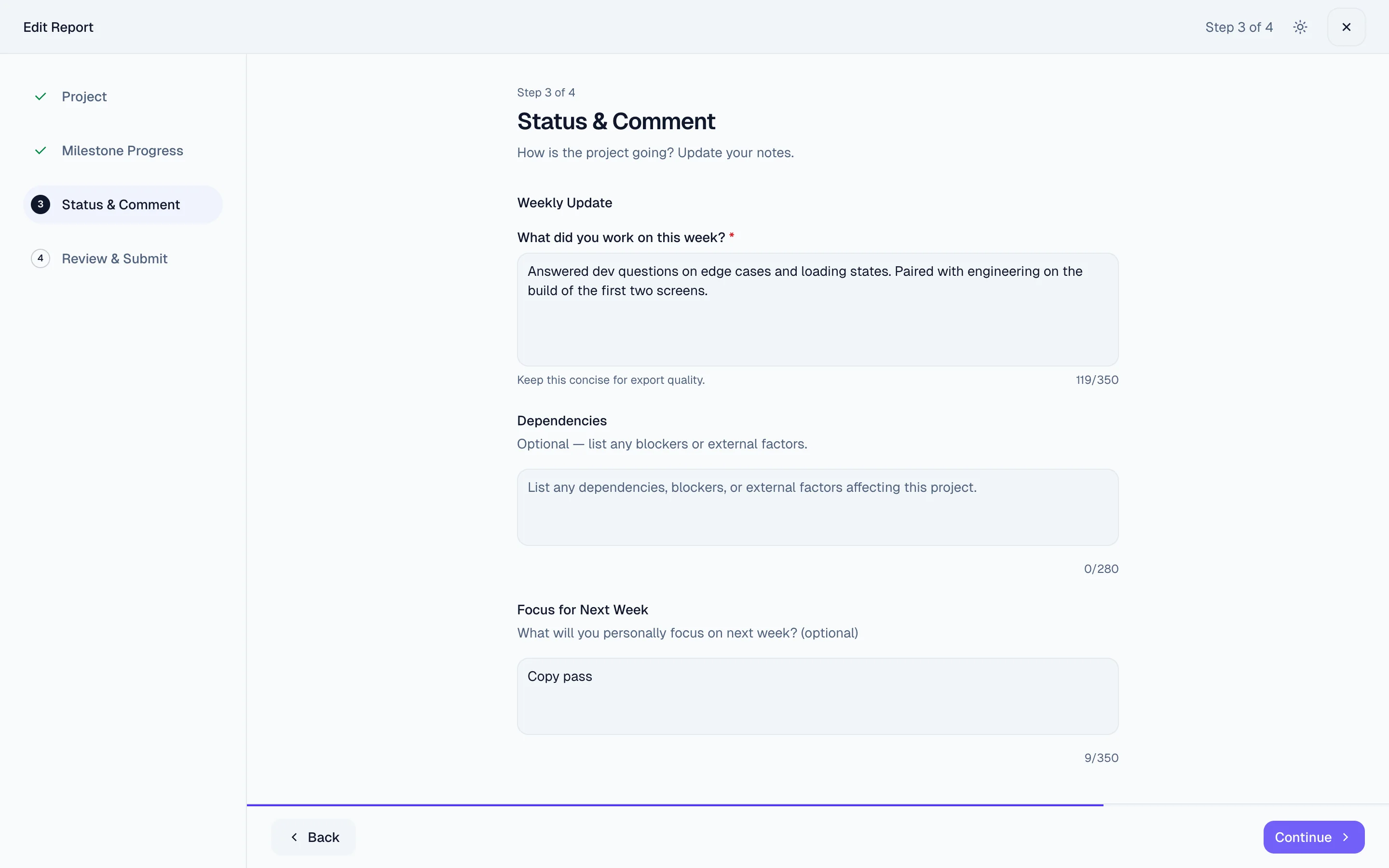
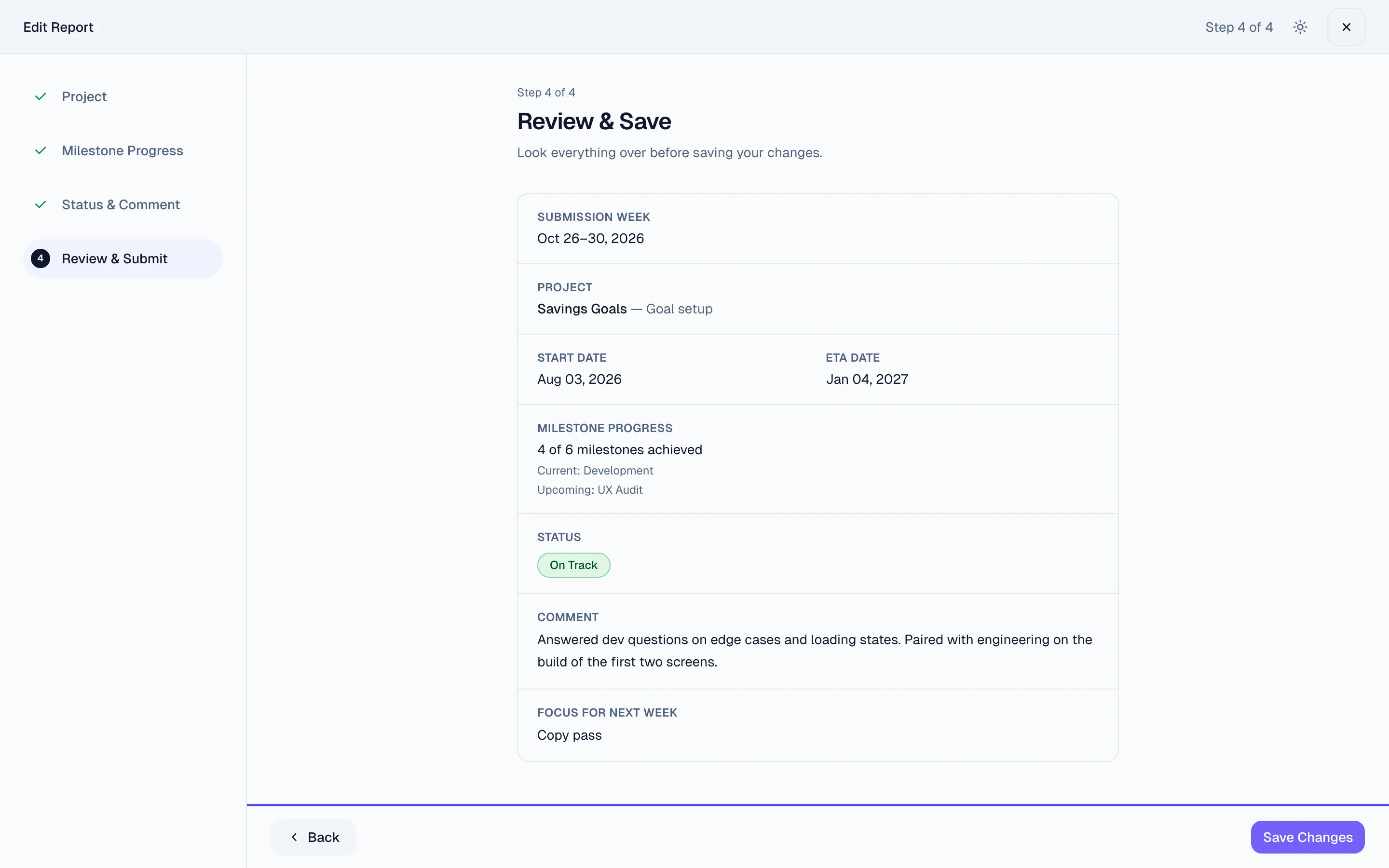
A report in Loupe is one project for one week, in four short steps: the project and its dates, the stage it's at, how it's going, and what's next. Loupe remembers the project, the feature and its dates from earlier weeks, so most weeks the first step is already filled in.

Decision 01P1 P2The chase and the deckThe problemsUpdates were collected one message at a time, then retyped into slides.

One report per project per week, in the deck's shape.

Every field a designer fills is a column the manager needs: stage, status, start and ETA dates, a comment, blockers, and next week's focus.

Instead of
A free-text update in chat. It's quick to send, and someone else has to find it, read it and retype it.
Trade-off
Four steps instead of one message. I kept each step short, filled in what Loupe already knows, and capped the comment at 350 characters, because it lands in a cell on a slide.
Proof
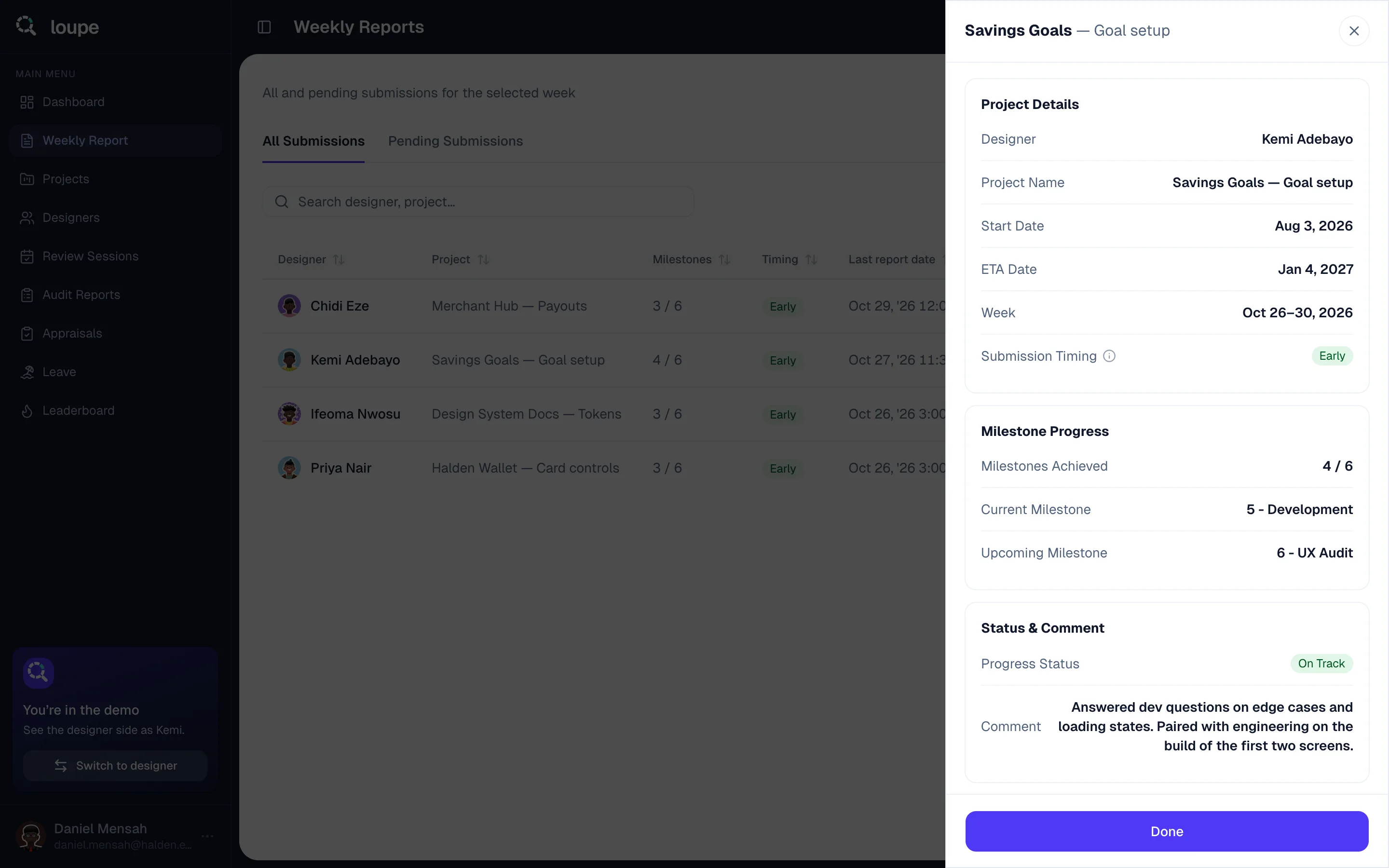
Nobody types it twice. The same report appears in the designer's history, the manager's table and the weekly deck. Follow one report through all three below.
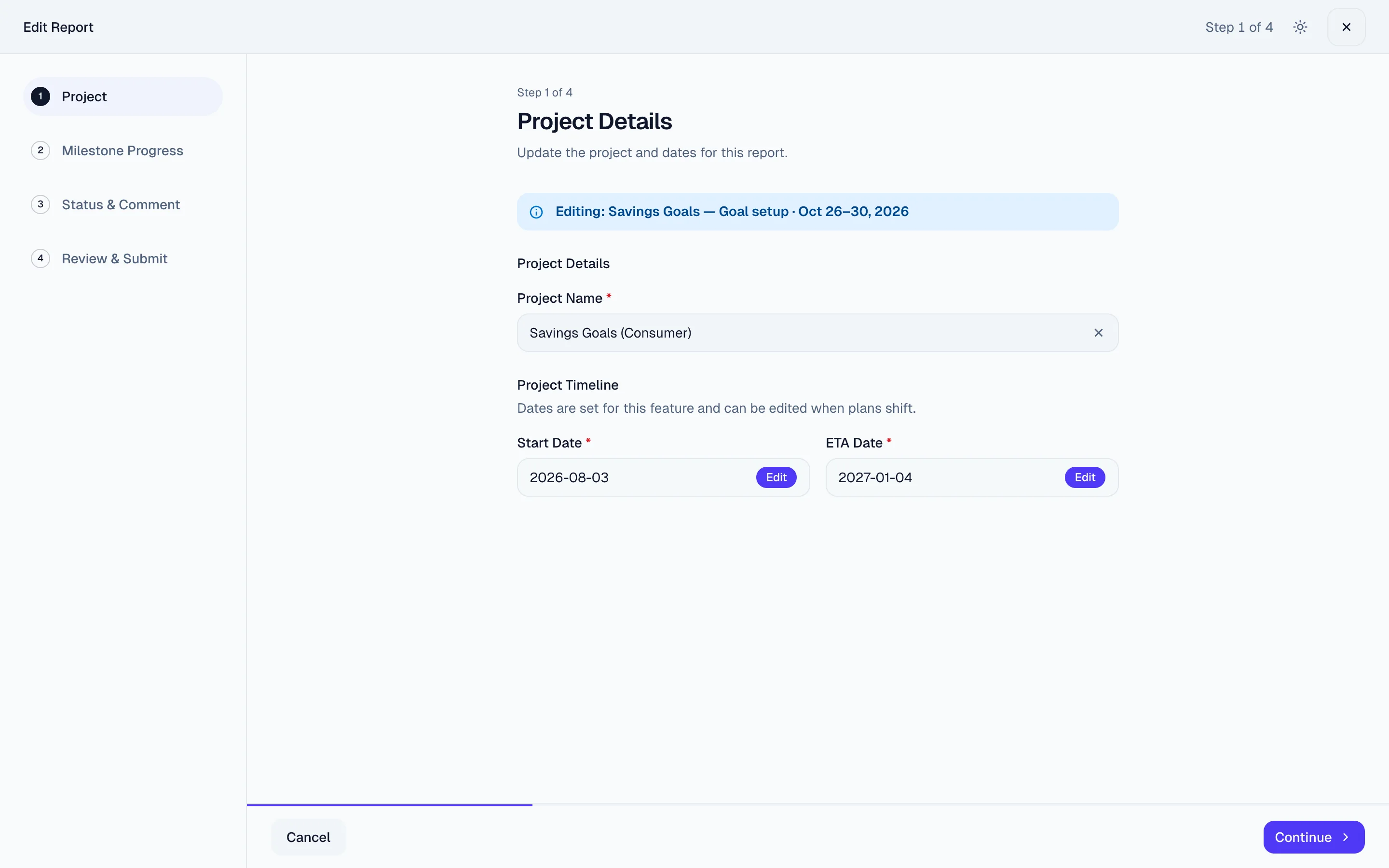
1. Project. Kemi, a designer, opens her Savings Goals report. The project, the feature and its dates come from earlier weeks.
One report, from Kemi to leadershipKemi, a designer, opens her Savings Goals report. The project, the feature and its dates come from earlier weeks.
  1. 1Design and prototype
  2. 2Testing and research
  3. 3Internal design review
  4. 4External design review
  5. 5Development
  6. 6UX audit

Every project moves along the same six stages. Reports, reviews and audits all hang off this one track, so a manager can compare any two projects.

Chapter 04Friday at four

One deadline everybody can see.

A report is on time if it's in by 4pm on Friday, Lagos time. At midnight that night it locks, and the week is closed. Early on Monday morning Loupe marks who missed and updates everyone's streak.

Decision 02P1The Friday chaseThe problemMy manager collected updates one message at a time.

A fixed deadline, then a lock.

On time means before Friday 4pm. Edits close at Saturday 00:00, so the numbers a manager presents are the numbers designers sent.

Instead of
Reports that stay open forever. Easy to fix a typo, and the numbers can change after the deck has gone out.
Trade-off
No quiet fixes later. A designer who forgets can't fill in last week afterwards. That's why the streak has a safety net, in Decision 03.
Proof
One screen shows who's missing. The manager's Pending Submissions tab and the designers page show who has sent this week and who hasn't.
The reporting weekLagos time

Times are Lagos time, from the app's scheduled jobs. Screens from the live demo, with made-up people.

Chapter 05The streak

Credit for showing up.

My friends had a fair complaint: doing the dull thing right every week earned nothing. So Loupe counts it. Every week your report is on time, your streak grows by one. The leaderboard ranks the team by current streak, and when two people tie, the one who usually submits earlier comes first.

It ranks one thing on purpose: showing up on time. It says nothing about who designed more or better. Counting screens or hours would reward volume, and the designer doing slow, careful research would always lose.

Streaks earn names as they grow: Spark at one week, Rising at two, Consistent at four, On Fire at seven, Blazing at ten and Legend at thirteen.

Decision 03P4Work nobody seesThe problemDesigners who showed up on time every week got no credit for it.

Rank showing up, and forgive one miss.

Four on-time weeks in a row earn a shield. You hold one at a time, and it covers exactly one missed week, so the streak survives. Approved leave never counts as a miss.

Instead of
Ranking output, like screens shipped. It rewards volume and punishes careful work.
Trade-off
Any leaderboard adds some pressure. I kept it to one thing everyone controls and made it forgiving. A shield covers a missed week. A late report still breaks the streak.
Proof
Leadership sees it too. The weekly deck ends on the submission leaderboard, with each designer's time and Early or Late beside it.

The rules are easier to feel than to read. Play a few Fridays below.

Try it · The streak

You're Kemi, the designer. It's Friday.

Choose what happens each week. Watch the flame, the shield and the team board.

  1. Spark1 week
  2. Rising2 weeks
  3. Consistent4 weeks
  4. On Fire7 weeks
  5. Blazing10 weeks
  6. Legend13 weeks

0weeks on time

Newcomer

No shield yet. One comes every 4 weeks in a row.

The team board as Daniel, the manager, sees it

    Teammates held still, so you can watch Kemi, the designer, climb.

    Friday 10 Jul

      Week 1 of 15Best streak 0 weeks

      Kemi has no streak yet. Send this week's report on time to light the first flame.

      The demo runs Loupe's own streak rules and level names, and the flames are the app's own animations. On time means before Friday 4pm. In the original app, 9 of the 14 designers reached Blazing and 6 reached Legend, 13 on-time weeks in a row. Source: the app's records, 27 October 2026.

      Chapter 06Review sessions

      Design reviews on a timetable.

      Reviews used to be booked in DMs. Loupe gives them a timetable: three one-hour sessions a week, at lunchtime on Tuesday, Wednesday and Thursday. Each session holds three designers, a designer takes one seat per session, and booking closes an hour before the session starts.

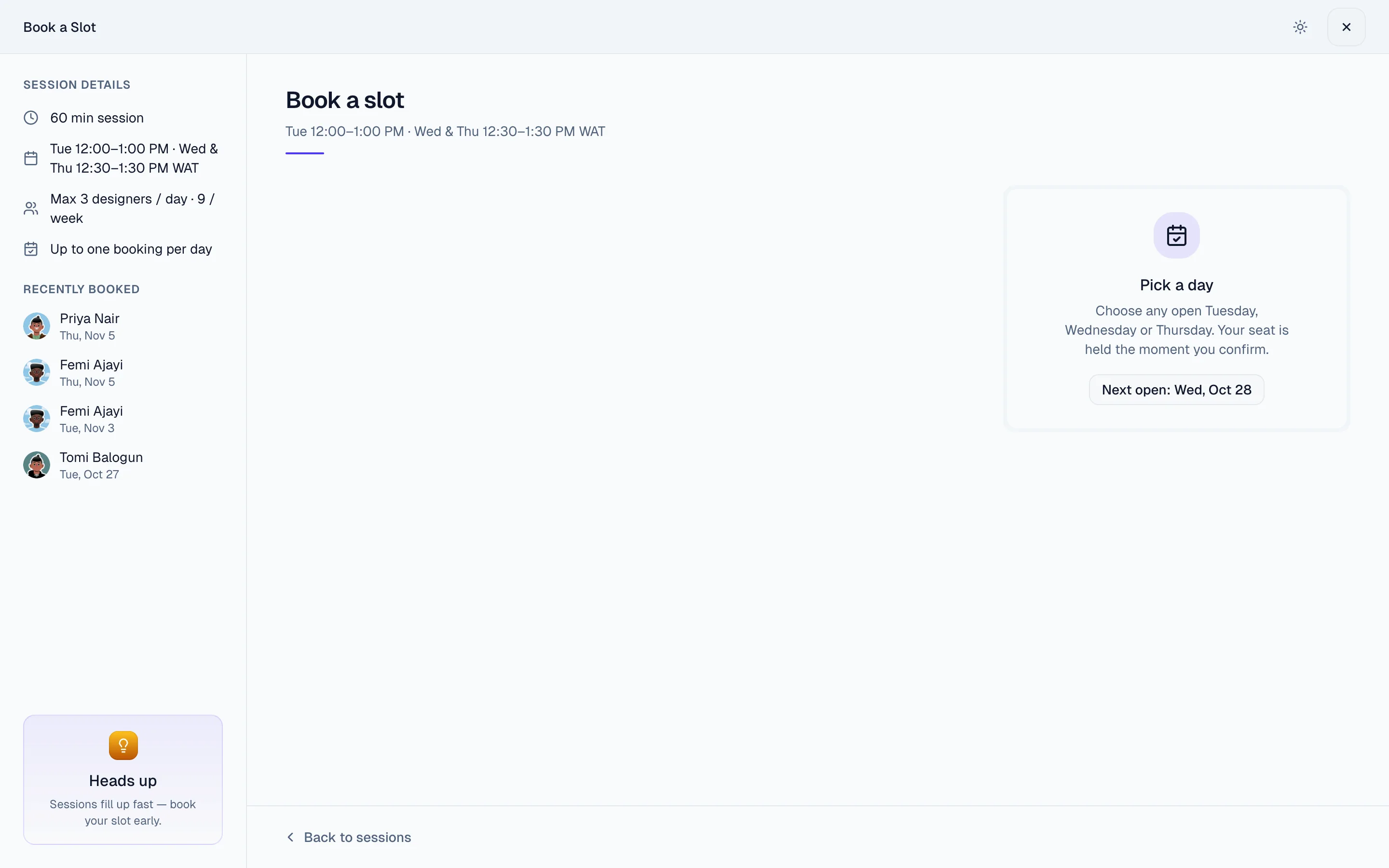
      A booking names the project, the type of review and a Figma link, so the reviewer arrives ready. The calendar shows who else is in each session, three weeks ahead.

      Decision 04P3Reviews over DMsThe problemReview slots were booked in messages, with clashes and no record.

      Fixed sessions with a small cap.

      Three sessions a week, three designers each, booked in Loupe against a real project.

      Instead of
      Booking reviewers one by one, or an open calendar link. Both lose the project, and both allow clashes.
      Trade-off
      Less choice of hour. In return nobody double-books, and every review leaves a record.
      Proof
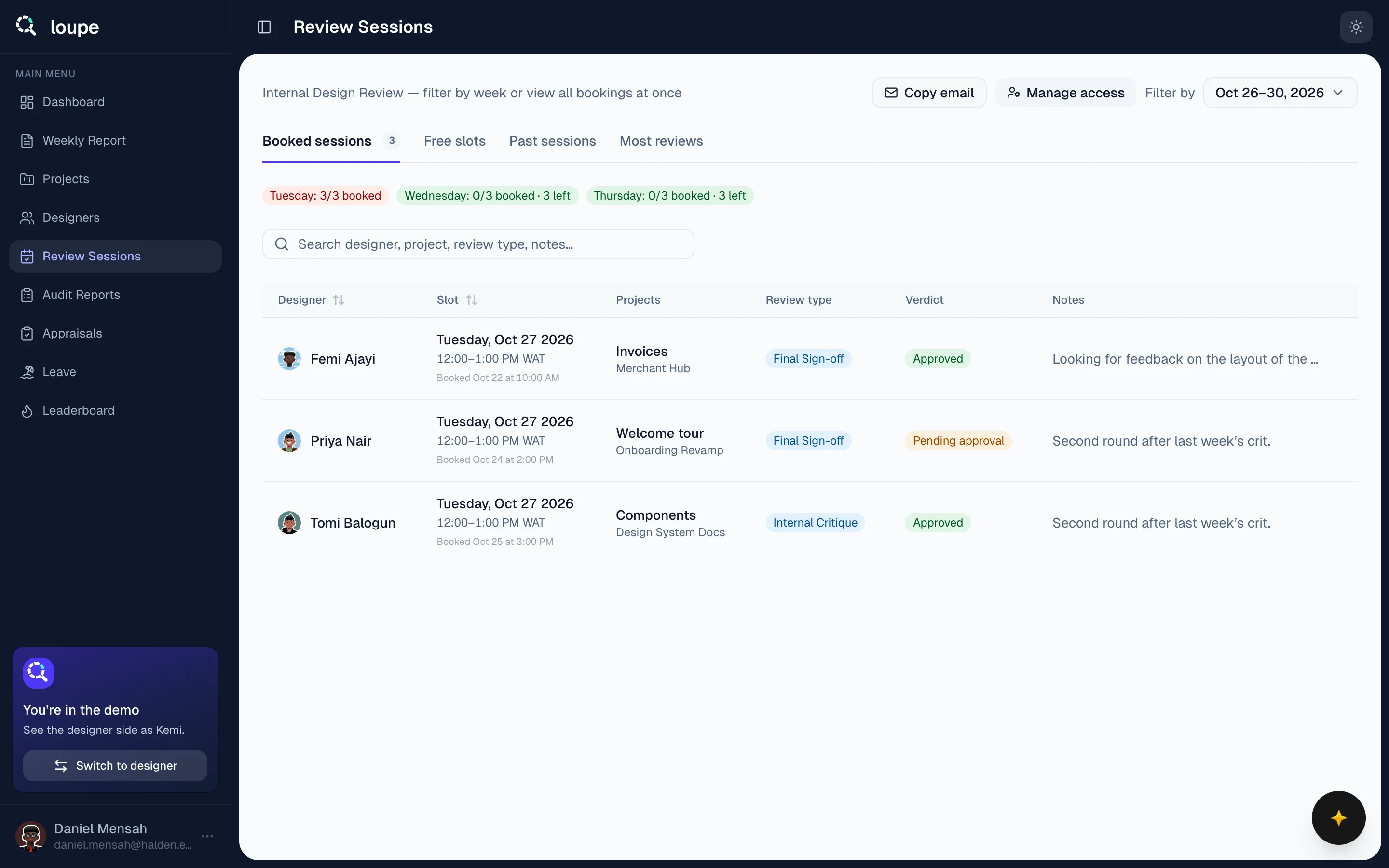
      One table for the manager. The week's sessions with project, review type and notes, a Copy email button that writes the schedule into an email, and a Most reviews ranking.
      Kemi books. Book a slot: three weeks of Tuesday, Wednesday and Thursday sessions, the open seats in each, and who's already in.
      Booking a review, both sidesBook a slot: three weeks of Tuesday, Wednesday and Thursday sessions, the open seats in each, and who's already in.
      Chapter 07The manager's week

      Monday morning, already written.

      Daniel, the manager, has a dashboard that answers the questions he used to ask in messages. How many projects reported this week? Who's missing? How many reviews are booked?

      Then the slides. Loupe makes three decks as real PowerPoint files, so he can still edit them before he presents.

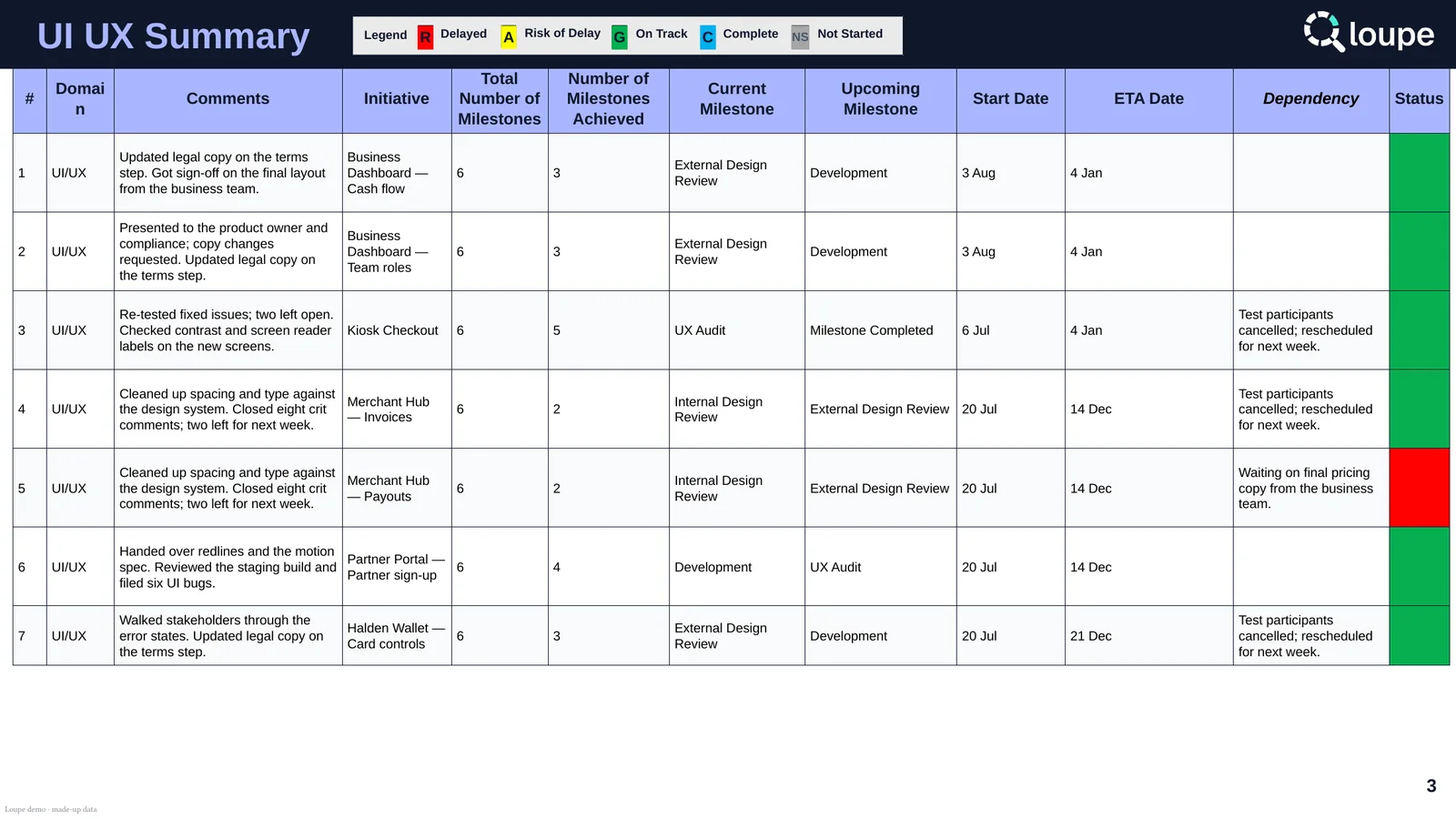
      Decision 05P2The deck by handThe problemThe same updates were retyped into slides for leadership every week.

      AI writes the summary, only from what designers wrote.

      Claude Haiku writes the leadership report's highlights, lowlights and focus from the week's reports. Every lowlight and focus line must name a real project from that week, or Loupe throws the answer away and builds a plain list instead.

      Instead of
      The manager summarising by hand, or a model writing freely. The first costs his Friday. The second can invent a project in front of leadership.
      Trade-off
      Plainer slides when the check fails. I'd rather show a plain list than a polished sentence about a project that doesn't exist.
      Proof
      No AI in the numbers. The project delivery report uses no AI at all. Its conclusion is counted from the submitted statuses, and the slide says so.

      Decks downloaded from the demo on 27 October 2026 and shown as images. In Loupe they arrive as editable .pptx files.

      And the rest of a design team's week.

      Reports, reviews and streaks are the core. The rest of a team's week sits beside them and uses the same people, projects and stages.

      Chapter 08How I built it

      One designer, three AI agents, seven months.

      I designed Loupe and built it end to end. Claude Code, Cursor and Codex were my engineering team. I wrote what each change should do, then reviewed and tested what they built before it shipped. The first version went from empty folder to working reports, a manager dashboard and a PowerPoint export in its first week.

      Skills, end to end

      1. 01Discover

        Research
        Conversations with designers and my manager, and a scan of the tools we had.
      2. 02Design

        Product design
        Two roles, six stages, the report's shape and the five decisions.
        UI and brand
        Dashboards, the report steps, tables, the logo and the illustrations.
      3. 03Build

        Front end
        Next.js pages, forms, tables, charts and motion.
        Back end
        An API, a database, the streak rules and jobs that run on a clock.
        AI
        Summaries in the leadership deck, with a check that throws out invented projects.
      4. 04Ship

        Testing and shipping
        86 automated API tests in the public copy, hosted on Vercel and Railway.
      The pipelineHow one report travelsEverything I designed and built, in the order a report moves through it.
      1. 01 · WriteThe web appKemi, the designer, fills in four short steps and sends. Next.js 14, TypeScript, Tailwind and Base UI, on Vercel.
        • TanStack Query and Table
        • Framer Motion
      2. 02 · Check and storeThe APINestJS checks the report, and Prisma saves it to PostgreSQL. Both run on Railway.
        • Fri 4pm deadline
        • Sat 00:00 lock
        • Mon 7am streaks
      3. 03 · Deliver
        • Daniel's dashboardThe manager sees the team's week, on time or not, ranked
        • The leadership deck python-pptx fills my template. Claude Haiku 4.5 writes the highlights
        • EmailSent through Resend

      One repo. pnpm and Turborepo hold the web app, the API and the types they share.86 API tests

      From the app's package files and test run on 27 October 2026.

      Commits295

      Days with commits52

      Busiest day13 May 28 commits

      One square is one day. Darker means more commits. Point at a month below to light up its days.
      1. Mar76 commits

        Weekly reports, the manager dashboard, the first deck, the Friday lock
      2. Apr44 commits

        Review sessions, leave, the streak leaderboard
      3. May68 commits

        UX audits, appraisals, the leadership deck written by AI
      4. Jun4 commits

        A quiet month
      5. Jul34 commits

        Shields, the 4pm deadline, Monday streak updates
      6. Aug15 commits

        Appraisals rebuilt, leave skips public holidays
      7. Sep14 commits

        Audit history, the team leave calendar
      8. Oct40 commits

        Review rankings, project reminders, then Loupe goes public

      Commits per day and per month, from the git history, 11 March to 19 October 2026.

      Making it safe to share.

      The version my team uses holds real people's reports, so the one you can try is a public copy with its own name. Loupe is a jeweller's magnifier, for looking at a week up close. The lens in the logo is seven segments, one for each day, and the mint one is this week's report.

      Inside is Halden, a made-up company: eight designers, twelve projects and ten weeks of history. The decks were restyled to match. Anything that could reach a real person is switched off: sign-up, password changes, invites, email and uploads. At 3am Lagos time every night, the demo wipes itself and starts again.

      Chapter 09Where it stands

      31 weeks with a real team.

      Since 23 March 2026, one in-house design team has run its week on the original: 14 designers and their manager. Below is every week so far. The purple part of each bar arrived before the Friday 4pm deadline, and the amber part came late.

      Reports per week, 23 March to 19 October 2026On timeLate
      1. 6
      2. 46

      The weekly records count 913 reports inside these 31 weeks, and 783 of them (85.8%) arrived on time. A report excused because the designer was on leave counts as on time. The week of 17 August had 6 reports, and the records don't say why. Over the same weeks, designers made 53 review bookings and submitted 24 UX audits. Deck downloads aren't logged, so I don't count them.

      See the numbers week by week
      March70 reports, 99% on time
      Week ofSentOn timeLate
      23 Mar33321
      30 Mar37370
      April135 reports, 78% on time
      Week ofSentOn timeLate
      6 Apr35269
      13 Apr362313
      20 Apr31238
      27 Apr33330
      May129 reports, 82% on time
      Week ofSentOn timeLate
      4 May34304
      11 May34340
      18 May33285
      25 May281414
      June124 reports, 85% on time
      Week ofSentOn timeLate
      1 Jun26197
      8 Jun23230
      15 Jun25178
      22 Jun26233
      29 Jun24240
      July97 reports, 93% on time
      Week ofSentOn timeLate
      6 Jul23230
      13 Jul26242
      20 Jul22184
      27 Jul26251
      August114 reports, 91% on time
      Week ofSentOn timeLate
      3 Aug33303
      10 Aug32320
      17 Aug660
      24 Aug21165
      31 Aug22202
      September118 reports, 88% on time
      Week ofSentOn timeLate
      7 Sep30300
      14 Sep29272
      21 Sep29218
      28 Sep30264
      October126 reports, 79% on time
      Week ofSentOn timeLate
      5 Oct35305
      12 Oct463214
      19 Oct45378

      Source: the company's own Loupe records, counted read-only on 27 October 2026. Test and admin accounts are left out.

      Try it as either side.

      Loupe is live. Sign in as Kemi, the designer, to send a report, book a review and watch your streak, or as Daniel, the manager, to read the team's week and download the decks. Press anything: it all resets tonight.

      What I'd do differently:

      1. Measure the before. I never timed the Friday chase or the slide-making before Loupe, so I can't show the hours it saves. Next time I'd write the baseline down in week one.
      2. Put the rules beside the feature. The streak, the shield and the lock are simple once explained, and at first I explained them in an announcement after launch. Each rule now lives on the screen that uses it.

      Credits

      Research, product design, brand and build
      Egbemode AbayomiWith Claude Code, Cursor and Codex
      The people it was built for
      My designer friends and my managerWho told me what hurt
      The demo team
      HaldenA made-up company. Every name is invented.

      LiveTry it as a designer or a manager (opens in a new tab)